Moving off an old Windows 7 PC, or setting up a new laptop for a relative who misses the old layout? Windows 11’s own settings can put Start and the taskbar icons in the bottom-left corner, color the title bars, restore This PC and Recycle Bin on the desktop, and set a familiar wallpaper. A real Windows 7-style Start menu is the one thing that needs a third-party app. Do the free, reversible built-in changes first, then decide whether an add-on is worth it.
Built-in settings versus add-on tools
This table shows which parts of the Windows 7 look Windows 11 can bring back by itself, and how much risk each route carries.
| Windows 7 feature | How to get it on Windows 11 | Risk |
|---|---|---|
| Start button and taskbar icons on the left | Built-in taskbar setting | None; one click to undo |
| A plain taskbar with no Widgets or Task view | Built-in taskbar setting | None |
| Colored title bars and taskbar | Built-in accent color settings | None |
| This PC, Recycle Bin and Network on the desktop | Built-in desktop icon settings | None |
| The full right-click menu every time | Registry change (not documented by Microsoft) or a shell tool | Low; one command to undo |
| Windows 7-style Start menu | Open-Shell (free) or Start11 (paid); StartAllBack (paid) restores a classic Start menu alongside its Windows 7 taskbar | Moderate; can break after a major update |
| Windows 7-style taskbar and File Explorer | StartAllBack (ExplorerPatcher brings back a Windows 10-style taskbar instead) | Moderate to higher; changes core parts of Windows |
| Aero glass windows and desktop gadgets | Not available, and not worth chasing | Gadget packs are a security risk (see below) |
If the person using the PC mainly wants to find things where they used to be, the built-in rows are often enough. That keeps a work laptop, or a relative’s PC you support from a distance, free of extra software that needs its own updates. It’s also the safer choice than keeping the old PC online: Microsoft ended Windows 7 support on January 14, 2020 and no longer publishes security updates for it, as its Windows 7 end of support FAQ explains.
Left-align the taskbar and strip it back
- Right-click an empty part of the taskbar and choose Taskbar settings.
- Under Taskbar items, turn off Widgets and Task view.
- Open the Search menu and choose Search box for a Windows 7-like search field, or Search icon only or Hide to keep the taskbar clean.
- Expand Taskbar behaviors and set Taskbar alignment to left.
Start now sits in the corner where Windows 7 kept it. Pin the apps the person used most by right-clicking each one in Start and choosing to pin it to the taskbar. Microsoft’s page on customizing the taskbar in Windows lists every taskbar option. For more taskbar-only tweaks, see making the Windows 11 taskbar look like Windows 10, which covers many of the same settings.
Colors that follow Windows 11’s mode rules
Windows 7’s default look was a blue taskbar and blue-tinted window frames. Windows 11 can get close, but one setting depends on another, which is why people often find it greyed out.
- Open Settings > Personalization > Colors.
- Set Choose your mode to Custom. Choose dark for the Windows mode (this controls Start and the taskbar) and light for the app mode, so apps stay bright the way they were on Windows 7.
- Set Accent color to Manual and pick a mid blue.
- Turn on Show accent color on Start and taskbar. This switch only works when the mode is Dark or Custom; in Light mode it stays grey.
- Turn on Show accent color on title bars and window borders.
- Leave Transparency effects on for a faint see-through taskbar. It isn’t Aero glass, but it’s the nearest built-in effect.
Microsoft’s guide to personalizing colors in Windows explains the mode rules.
Wallpaper, desktop icons and Control Panel
- Desktop icons: go to Settings > Personalization > Themes > Desktop icon settings, check This PC, Recycle Bin, Network and the user’s files folder, and click OK.
- Wallpaper: go to Settings > Personalization > Background, set Personalize your background to Picture, and click Browse to pick an image. Windows 11 doesn’t include the Windows 7 wallpaper, so use a family photo or any picture you have rights to rather than downloading “Windows 7 theme” packs, which can bundle unwanted software.
- Save it as a theme: back in Personalization > Themes, choose Save and give the theme a name so you can reapply the whole look in one click later.
- Control Panel: press Windows key + R, type
control, and press Enter. Right-click its taskbar button and pin it if the person uses it often.
Microsoft documents the desktop icon settings on its support site. The Themes page also has a Sounds option, but Windows 11 doesn’t ship a Windows 7 sound scheme.
Windows 11 shows a short menu first, and the full menu Windows 7 users expect sits behind Show more options at the bottom. That’s Microsoft’s supported route. You can also press Shift + F10 on a selected file, or hold Shift while you right-click, to open the full menu directly.
To always get the full menu, a registry change is widely used. Microsoft doesn’t document it, so treat it as a tweak that a future update could stop honoring. It only affects the current user.
- Right-click Start and choose Terminal.
- Paste this command and press Enter:
reg add "HKCU\Software\Classes\CLSID\{86ca1aa0-34aa-4e8b-a509-50c905bae2a2}\InprocServer32" /f /ve - Restart the PC, or restart Windows Explorer from Task Manager.
To undo it, run reg delete "HKCU\Software\Classes\CLSID\{86ca1aa0-34aa-4e8b-a509-50c905bae2a2}" /f and restart. More options for trimming the menu are in this walkthrough on changing right-click options in Windows 11.
Every tool in the next section replaces part of the Windows shell (Start, the taskbar or File Explorer). That’s what makes them work, and it’s why they can misbehave after a big Windows update. A few precautions make the difference between a quick fix and an afternoon of repair.
- Create a restore point first. Search Start for Create a restore point, select the system drive, and click Create. If protection is off for that drive, turn it on with Configure first. If something breaks, you can roll back from the same window.
- Use one shell tool at a time. Two programs trying to replace the same taskbar or Start menu is the most common cause of trouble.
- Download only from the official site or the project’s own GitHub releases page. Copies on download mirrors are where bundled extras turn up.
- Expect to need administrator rights. ExplorerPatcher’s installer, for example, asks to elevate and closes File Explorer while it works. On a work PC, ask IT before installing anything.
- Read ExplorerPatcher’s release notes first. Its releases page warns that some security software must be told to allow its files, and that File Explorer won’t start if one of those files is blocked. On a PC with company-managed security software, skip it.
- On a Windows on ARM PC, skip Open-Shell. Its project page warns that older versions on ARM can block sign-in after a restart.
Two things are worth leaving alone entirely. Desktop gadget packs revive a feature Microsoft removed because of security flaws: Microsoft says vulnerabilities existed that let even harmless-looking gadgets be exploited, as explained on its desktop gadgets removal page. And “one-click Windows 7 makeover” scripts change dozens of registry and system settings at once, often with no license, no releases and no easy way back. Change one thing at a time instead, so you always know what to undo.
| Tool | Cost and license | What it restores | Best for |
|---|---|---|---|
| Open-Shell | Free, open source (MIT) | Classic, two-column or Windows 7 Start menu styles | Someone who only wants the Start menu back |
| StartAllBack | Paid; check its site for trial terms | A restored Start menu plus a Windows 7-style taskbar, flyouts and File Explorer | The closest overall match, kept up to date |
| Start11 (Stardock) | Paid, free trial offered | Start menu and taskbar, including a Windows 7 style | People who want a polished commercial product |
| ExplorerPatcher | Free, open source (GPL-2.0) | A Windows 10-style taskbar (not a Windows 7 one) | Comfortable tinkerers; pairs with Open-Shell for some users |
StartAllBack’s changelog shows regular releases for current versions of Windows 11, which matters because shell tools live or die by how fast they’re fixed after updates. Open-Shell and ExplorerPatcher are both active projects on GitHub (ExplorerPatcher’s repository has its own install and uninstall notes), but neither promises support for a specific Windows 11 version. For most families helping a Windows 7 user, Open-Shell is the low-cost place to start, since it touches only the Start menu.
- Go to the latest stable Open-Shell release on GitHub and download the setup file.
- Run the installer. On the list of components, keep Open-Shell Menu and turn off the parts you don’t need, such as Classic Explorer and Classic IE.
- When the Open-Shell Menu settings window opens, stay on the Start menu style tab and pick the Windows 7 style.
- Optionally, choose to replace the Start button with a different picture, and pick a skin on the skin tab. Names vary by version, so look for the Windows Aero options.
- Click OK.
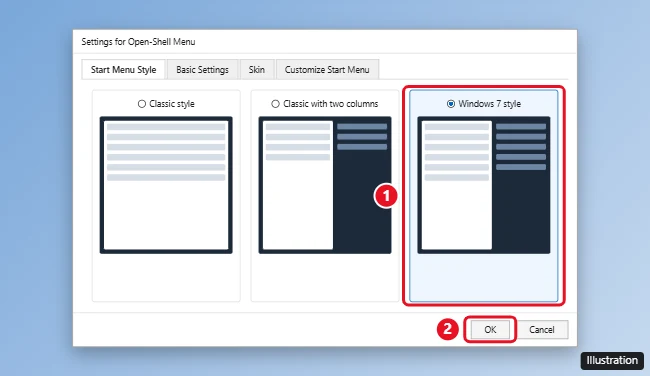
Press the Windows key to check the new menu. To change it later, right-click the Start button and open Open-Shell’s settings. If Windows 11’s own Start button still shows beside Open-Shell’s, revisit the Start button replacement option, or keep the taskbar centered and let Open-Shell take over only the Windows key. For further tweaks to the menu Windows 11 ships with, see customizing the Windows 11 Start menu.
Undo plan: put everything back
| Change | How to reverse it |
|---|---|
| Taskbar on the left, items hidden | Taskbar settings: set alignment back to center and turn items back on. |
| Colors | Personalization > Colors: set the mode to Light or Dark and accent color to Automatic. |
| Desktop icons and wallpaper | Clear the icons in Desktop icon settings; pick a Windows theme in Themes. |
| Full right-click menu | Run the reg delete command above and restart. |
| Open-Shell, StartAllBack, Start11, ExplorerPatcher | Settings > Apps > Installed apps, select the app, then Uninstall, and restart. |
| Anything that won’t uninstall cleanly | Roll back with the restore point you created. |
If the taskbar or Start menu stops responding after a Windows update, uninstall the shell tool first, restart, then check its official site for a newer version before reinstalling.
Classic Windows look questions
Is Open-Shell safe to download?
It’s open source under the MIT license, and its GitHub page says releases are code-signed. That’s a good sign, not a guarantee. Download only from the project’s own releases page, never from a mirror, and avoid it on Windows on ARM.
Can I run two of these tools together?
Avoid running two tools that replace the same part of Windows. Some people pair ExplorerPatcher’s taskbar with Open-Shell’s Start menu, but every extra shell tool is one more thing that can break after an update.
Can I bring back the Windows 7 games?
Not the originals. Microsoft publishes newer versions of Solitaire and Minesweeper in the Microsoft Store; search for them there. They look different but play the same way.
Start with the taskbar and color changes, live with them for a few days, and add Open-Shell only if the Start menu is still the sticking point. If a Windows 10 feel suits better, this walkthrough on making Windows 11 look like Windows 10 takes a similar approach.

Kermit Matthews runs Live2Tech from just outside Philadelphia. He started on a university help desk, spent years as the IT person for small businesses, and has been writing tech guides full time since 2020. Each guide is checked on a device he owns, and re-checked when a menu moves. More about Kermit.