The easiest way to loop a video on Windows 10 is with the Media Player app: open the video, then click the Repeat button (two arrows in a loop) at the bottom right of the controls until it shows Repeat one. The video starts over every time it ends. In the classic Windows Media Player, press Ctrl + T to turn on repeat. In VLC, click the Loop button or choose Playback > Loop (on older versions, Toggle Loop in the controls).
Below are the steps for each player, plus how to loop just part of a video and how to loop YouTube videos in a browser.
Which app should you use?
| App | How to loop | Loop part of a video? |
|---|---|---|
| Media Player (new) | Repeat button | No |
| Windows Media Player (Legacy) | Ctrl + T | No |
| Movies & TV | Repeat button, in versions that have it | No |
| VLC (free) | Loop button | Yes, with A-B repeat |
Method 1: Loop a video in Media Player
Microsoft’s newer Media Player app replaced Groove Music on Windows 10. If you don’t have it, install Media Player from the Microsoft Store.
- Right-click the video file and choose Open with > Media Player.
- Move your mouse over the video to show the controls.
- Click the Repeat button at the bottom right. Click it until it shows Repeat one (with a small “1”) to loop the current video. Repeat all loops everything in the play queue.
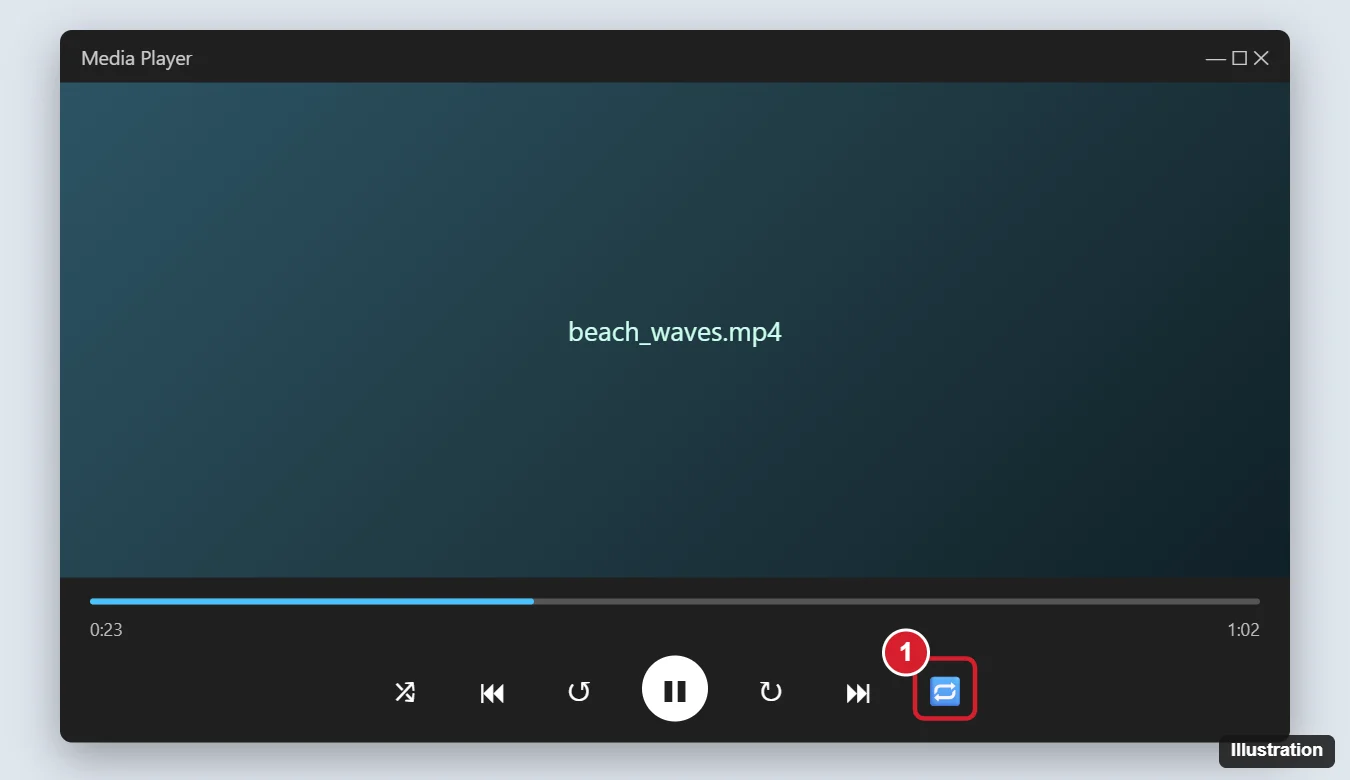
You can also press Ctrl + T in Media Player to cycle through the repeat modes.
Method 2: Loop a video in Windows Media Player (Legacy)
- Click Start, type Windows Media Player Legacy (or Windows Media Player), and open it.
- Open your video.
- Press Ctrl + T, or click the Repeat button next to the shuffle button in the controls.
If you’re in Now Playing mode and don’t see the button, right-click the video and choose Repeat. If Windows Media Player isn’t installed, add it in Settings > Apps > Optional features > Add a feature.
Method 3: Loop a video in Movies & TV
- Open the video in Movies & TV.
- Look for the Repeat button in the controls, or click the three-dot More options button and choose Repeat.
Microsoft has changed Movies & TV over time, and some versions don’t include repeat. If you don’t see it, use Media Player or VLC instead.
Method 4: Loop a video (or part of it) in VLC
VLC is a free, open-source player from videolan.org that plays almost any video format.
Loop the whole video
- Open the video in VLC.
- Click the Loop button (two arrows in a circle) in the bottom controls. Click once for loop all, and again for loop one.
- Or press L on your keyboard to cycle through the loop modes.
Loop just part of a video (A-B repeat)
- Click View > Advanced Controls to show extra buttons.
- Play the video to where you want the loop to start, then click the A-B button once to set point A.
- Play to where you want the loop to end and click A-B again to set point B.
- VLC now repeats that section. Click A-B a third time to turn it off.
Loop YouTube and other online videos
- YouTube: Right-click the video (not an ad) and choose Loop. Right-click again and uncheck it to stop.
- Other sites: Many browser-based players don’t have a loop option. Right-clicking a plain HTML5 video sometimes shows Loop, depending on the site and your browser.
Make a video that loops everywhere
If you need a video to loop on a site or device that doesn’t support looping, you can repeat the clip several times in a video editor like Clipchamp, which comes with recent versions of Windows, and export it as one longer file. For a looping animation, you can also convert a short clip to a GIF.
Frequently asked questions
Why doesn’t Windows 10’s Photos app loop videos?
The Photos app doesn’t have a repeat option. Open the video in Media Player or VLC instead.
How do I loop a video when presenting in PowerPoint?
Select the video, click the Playback tab, and check Loop until Stopped.
Does looping use more battery or data?
Looping a local file uses about the same power as normal playback. Looping an online video can use data each time it reloads, depending on the site.

Kermit Matthews is a freelance writer based in Philadelphia, Pennsylvania with more than a decade of experience writing technology guides. He has a Bachelor’s and Master’s degree in Computer Science and has spent much of his professional career in IT management.
He specializes in writing content about iPhones, Android devices, Microsoft Office, and many other popular applications and devices.